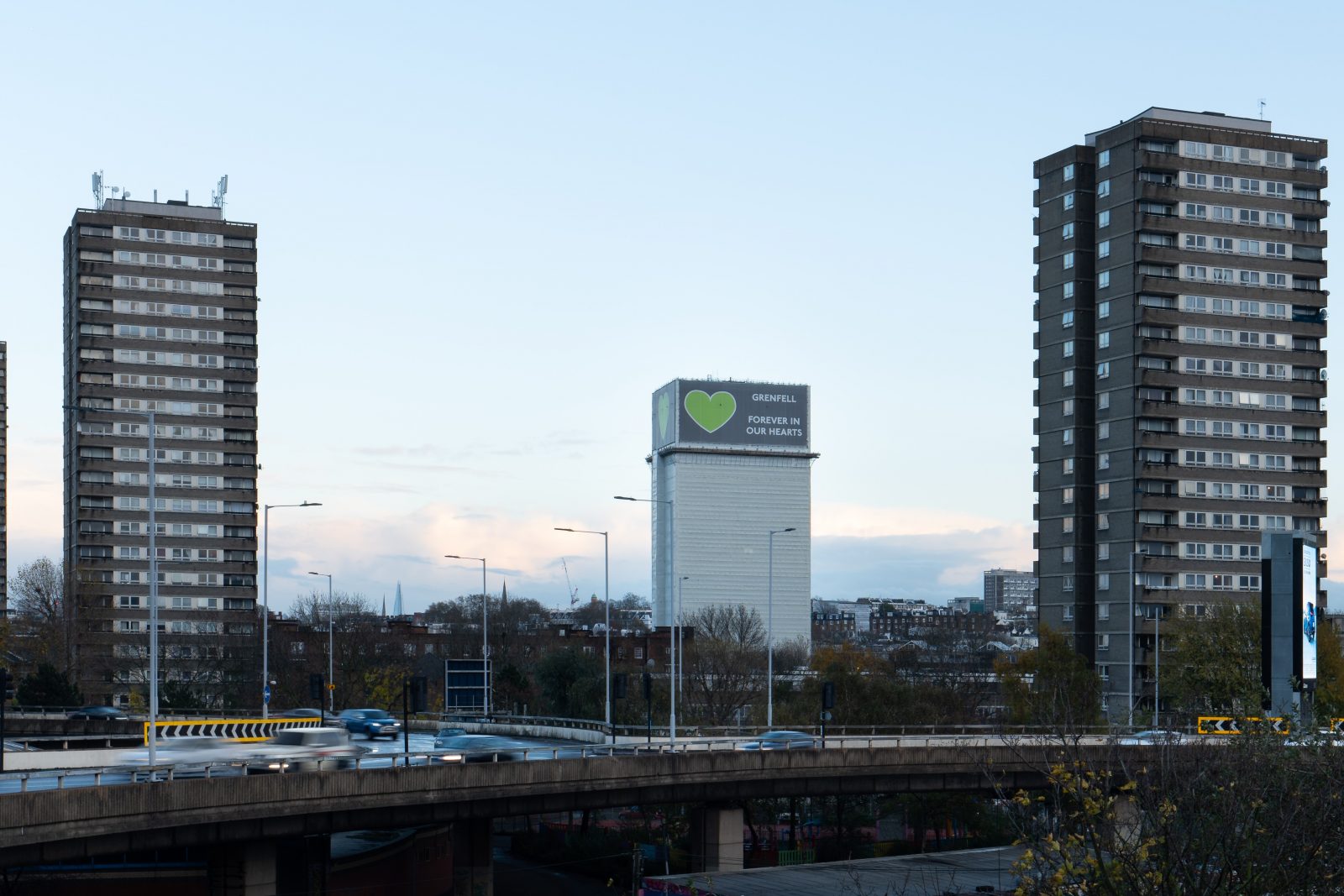
Source: Guy William / Shutterstock.com
Four years after the tragic fire that killed 72 people, the UK remains in the grip of a spiralling building-safety crisis. What has it been like for the architects involved, and is the profession doing enough to help the half a million residents trapped in unsafe properties?
‘I’ve been an architect for 30 years, but when I bought my flat I was fooled.’ Gary Pemberton, director at an AJ100 practice, lives in a flat caught up in the UK’s cladding crisis. Riverside Quarter, designed by Carey Jones Chapman Tolcher (CJCT) on the banks of the Thames in Wandsworth needs significant recladding.
A waking watch has been installed at residents’ expense but the block has been rejected twice for government funding. Developer Frasers says while it will work ‘tirelessly’ to challenge the decision, if unsuccessful then leaseholders will bear the remediation costs –a staggering £2 million between 54 residents.
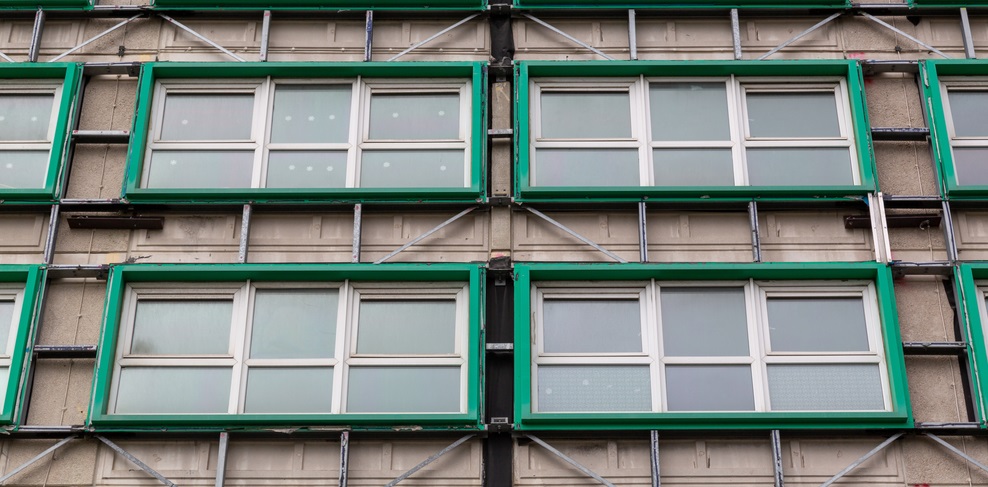
Pemberton is a victim of the UK’s building safety scandal that emerged in the wake of the Grenfell fire, which killed 72 people four years ago. It is estimated that about 274,000 flats have been fitted with dangerous cladding, affecting more than 650,000 people. But flammable cladding is just the tip of the iceberg with investigations of buildings up and down the country revealing a litany of fire-safety and other issues.
The scandal and the revelations emerging simultaneously from the Grenfell Tower Inquiry continue to have a huge impact on architects, with skyrocketing professional indemnity insurance cover and high levels of concern over fire-safety, liability and product safety. Last month’s AJ survey of nearly 300 architects on the fire-safety crisis gives a fascinating insight into how the fire continues to have an impact on architects’ day-to-day working lives.
Hundreds of practices have had buildings caught up in the crisis and the AJ has spoken to some of those directly affected, including ECD Architects, which described finding out one of its buildings had ACM cladding in the wake of Grenfell; and Darling Associates, which discovered that materials they had specified had been substituted by contractors.
‘The “profession” has not responded to Grenfell. It has largely been silent’
Anonymous survey respondent
The sheer number of buildings that need fixing has resulted in plenty of work for architects in the high-rise sector, not least because cladding is being stripped away only to reveal what ECD Architects’ James Traynor calls a ‘can of worms’. Problems include poorly fitted insulation, missing cavity barriers and cladding being removed to leave blocks uninsulated and cold for months on end.
This month, flat owners held protests at developers’ marketing offices around the UK – a reminder of how the cladding crisis has become a nationwide scandal. But as part of an industry held responsible for the problem, architects seem unsure if they can, or should, be part of the solution, at least for now. Many want to wait for the Grenfell Tower Inquiry to come to its conclusions. But could not the profession – as one architect has urged – begin to use its skills to help ‘untangle’ the mess and to rebuild trust?
As the cladding crisis has snowballed, a huge range of buildings have been affected. Of the 469 high-rises found with ACM cladding, 156 are council blocks, some which had been reclad during refurbishments, such as HTA’s Chalcots Estate in Camden. ACM was also found on housing association blocks like Levitt Bernstein’s Bolanachi Building in Southwark, as well as 215 private-sector tower schemes.
Concern has spread from ACM to other unsafe materials, such as high-pressure laminate (HPL) as used on RADM Architects’ fire-hit Cube student flats in Bolton; and timber after a serious fire in 2019 spread across wooden balconies at a Sheppard Robson-designed block in Barking. Many timber-clad buildings are facing remediation works, including Hawkins\Brown’s Prowse Court in Enfield and shedkm’s Moho Manchester scheme for Urban Splash. Other practices with buildings caught up in the crisis include Broadway Malyan, PRP, MDR Associates (now Fuse Architects), AHR and David Miller Architects.
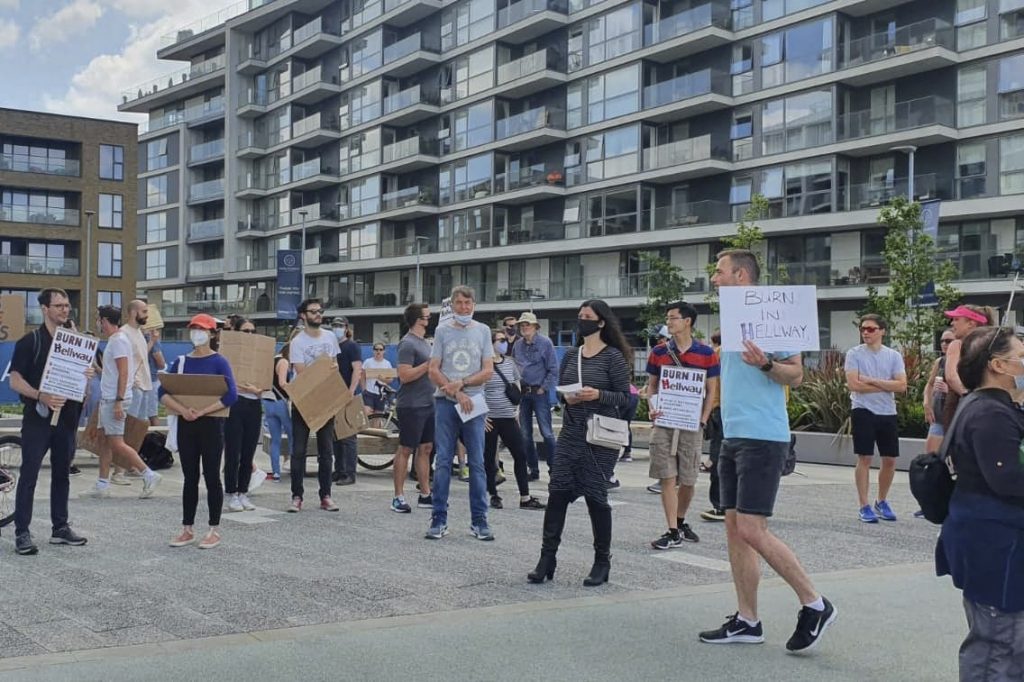
Getting developers to remove cladding has been slow work due to the painful negotiations over who should pay. The government has set aside a pot of £5.1 billion to fix the problem, but the Housing, Communities and Local Government Committee has estimated the cost could be more like £15 billion.
The Building Safety Fund also only covers cladding and is only for buildings above 18m, leaving millions of leaseholders in lower blocks left footing the bill themselves. ‘We’re facing financial ruin and bankruptcy because of fire safety issues we did not cause,’ said campaigners from End Our Cladding Scandal last week ahead of the nationwide protests aimed at shaming developers into paying for the remediation.
‘Almost every practice will be feeling nervous about at least one of their buildings’
Anonymous survey respondent
Developer Ballymore faced criticism last month after a fire broke out at New Providence Wharf, an SOM-designed development in east London. The building was still partially clad in ACM, four years after Grenfell, despite the government asking ‘for months’ for it to be removed. A fire report last month found the building acted like a ‘chimney’ due to a failed ventilation system, and while the ACM did not contribute to its proliferation, the fire was spread across the flats’ timber decking.
The AJ approached 19 practices, including those mentioned above, but almost all declined to talk about their buildings or the cladding crisis. Speaking publicly about the issue is a ‘real challenge’ for practices, according to Broadway Malyan’s Ian Apsley, who says his practice has been required to sign ‘onerous non-disclosure agreements’ as owners are so sensitive to the issues.
‘We can talk about [issues] in a high-level sense,’ he says, ‘but talking about the real technical challenges that are out there and helping the industry solve them is very challenging right now.’
ECD managing director James Traynor says after seeing reports in the press, the practice checked its archive records and found the tower had the same type of ACM cladding as used at Grenfell, though importantly, with rock mineral wool insulation behind the cladding.
‘I felt nervous in 2017 [when it emerged Ferrier Point had ACM],’ he said. ‘But we had a full set of records and specification and the contract which showed who had design liability and responsibility for the detailing. I was reassured, but I think the broader issue of concern was for the wellbeing of occupants at the time the cladding was on the building.’
‘We should stand by our designs and own the problem, meaning many of us need to take the blame for lazy oversight and buck‑passing’
Anonymous survey respondent
He added: ‘It’s hard to separate how I feel now and then. Now I feel quite angry because of everything that’s come out of Grenfell. I’m not making excuses, but I think some of the manufacturers clearly pulled the wool over our eyes.’
The Grenfell inquiry has heard evidence that manufacturers whose materials were installed on the west London tower during its upgrade were gaming the testing system. It heard that companies used product safety certificates incorrectly in marketing campaigns, and added undisclosed components to testing rigs to help their products pass safety tests.
According to the AJ survey, almost three-quarters of architects now carry out more checks on materials following the Grenfell Tower fire and changes in regulations, such as the ban on all combustible materials in the external walls of buildings over 18m. Many said they refused to specify materials made by Grenfell product manufacturers Celotex and Kingspan even though combustible insulation is still permitted on buildings under 18m and widely used. A recent industry study showed that over 70 new school buildings had been built with combustible insulation since the Grenfell fire.
‘We are no longer able to rely on manufacturers’ information without further investigation of British Board of Agrément and other certification, to confirm that the claims of compliance are met,’ said one survey respondent. Another added that they have stopped specifying anything that has not been certified in France and Germany as ‘the UK process of certification is clearly broken’.
In addition to the shocking revelations from product manufacturers, one of the biggest issues to emerge from the inquiry has been the devastating consequences of cost-cutting and value engineering under design and build.
Darling Associates’ Chris Darling says the practice designed a residential tower where the insulation material it specified was changed at a later date by the contractor to combustible insulation.
‘The whole of the construction industry needs to exert pressure on the government to fund the removal of ACM panels’
Anonymous survey respondent
‘We correctly specified inert insulation – this has always been our policy; it just seems basic common sense. However, the building was subsequently constructed – without our knowledge – with a combustible insulation within the cladding.
‘Going forward, especially in the case of high-rise buildings, architects should be required to be more involved in overseeing the eventual construction. This quality control just seems to fall between far too many stools.’
One survey respondent said they realised after checking records that the proposed cladding on one of their designs was unsafe, but the building was already on site. They said: ‘We advised the design-and-build principal contractor to change the specification before installing the cladding but they installed at risk. It then had to be changed later.’
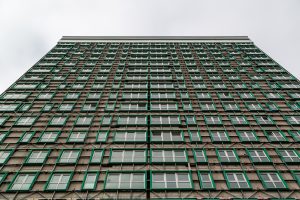
Source:Gary L Hider / Shutterstock.com
A tower block that has had its cladding removed due to being a fire hazard after the Grenfell Disaster, Horatia house, Portsmouth
Source: Gary L Hider / Shutterstock.com
And architects who have helped remediate buildings have been shocked by what they are finding. PRP’s Andrew Mellor has uncovered poorly installed insulation, missing cavity barriers, and loose cladding support framework – while ECD’s Traynor says his practice had worked on towers ‘where insulation hasn’t been fixed to the building and is hanging off, 25-storeys up’.
‘It’s a concern,’ agrees an anonymous architect, who has worked on the remediation of 14 unsafe tower blocks. ‘The quality of the installation is substandard, materials are not the product they claim to be, they are not installed to the original details and fire barriers are missing.’
To make matters worse, architects are often employed for remediation jobs late in the day – leading to concerns that further defects are being missed in external walls. Traynor reports the same problem.
‘There’s been a tendency to defer the design to later in the project until after a contractor is appointed,’ he says. ‘We’ve turned down projects where we have concerns over what we have seen.’
‘It is very telling that the architecture profession has not been one of the leading voices on reform or technical analysis. It means the general public have lost trust in our profession’
Anonymous survey respondent
Leaseholders living in unsafe blocks have told the AJ they faced radio silence when contacting architects that designed their buildings. Lynne Hamshaw’s daughter lives in a CJCT-designed development in Clarence Dock, Leeds, which has flammable cladding and other problems. She showed the AJ an email she wrote to the architect seeking information on who built the block. Hamshaw says she never received a reply.
‘Leeds Dock development was a prestige site from which the developers, architects and all concerned will have made many millions of pounds,’ she says. ‘None of them have stepped forward to admit any financial responsibility or offer help. Instead, architects and the construction industry stand to make another financial killing, off the backs of leaseholders, when remediation work takes place.’
Block owner Lendlease says it has ‘great sympathy’ for leaseholders but it neither planned nor built any of the properties at Clarence Dock. This was done by Berkeley Group, which refused to comment.
Another leaseholder in east London, who did not wish to be named, says they contacted architect RM_A for drawings to find out what materials were used on their block but the architect said it didn’t hold copyright and couldn’t share drawings. Neither RM_A nor CJCT responded to the AJ’s requests for comment.
Paul Afshar, from End Our Cladding Scandal, says that ‘first and foremost’ architects need to have people at the heart of design principles. ‘Liveability, safety and accessibility are all things that unfortunately we don’t see in abundance in new build blocks,’ he adds.
‘Without these principles, it’s difficult to see a way out of the cladding crisis as profit remains the main driver – a problem which has led to shoddy construction and cut corners.
‘An architect is one of the first people to be able to put the brakes on bad decisions, whether it’s the absence of a cavity break, not having the right fire-detection system or questionable cladding.’
Pemberton’s expertise allowed him to look at drawings of Riverside Quarter and clarify to the residents’ committee why his block had been refused funding. He soon found himself spending days writing to his local MP and contributing to the appeal of the government’s refusal. ‘Some people are getting funds granted, some aren’t and [leaseholders] don’t have the technical expertise to contest it,’ he says.
Not every leaseholders’ group is fortunate enough to have a construction industry professional as part of their team. But is that such a far-fetched idea? Chris Williamson of Weston Williamson has called for architects to volunteer as ‘intermediaries’ to help advise residents – an effort he says could be co-ordinated by the RIBA. Other survey respondents suggested the industry as a whole should be contributing, with one saying: ‘Contractors, developers and consultants should join to provide and pay for professional advice, surveys, risk assessments and specifications for remedial works to people living with flammable cladding.’
The RIBA’s lead on fire safety, Jane Duncan, says the institute could potentially ‘stump up something’ to help, but that for individual architects that might not be feasible. ‘Is a practising architect supposed to be an advocate for a resident?’ she asks. ‘If a resident comes to you looking for a professional response you need to be careful.’
Almost 40 per cent of survey respondents felt the profession had responded ‘poorly’ to the Grenfell Tower fire and the findings of the inquiry.
But there is disagreement about the best route forward and whether architects should be lobbying the government, upskilling, making more noise over marginalisation or simply focusing on doing their job.
Tim O’Callaghan of nimtim architects says the profession should have a ‘louder and clearer voice’ and should start to call out contractors who have changed proposals for cost reasons.
PRP’s Mellor says architects should consider ‘applying pressure’ to manufacturers to ensure they are ‘accurately promoting and selling their products as even today, we are finding some are not’.
But some don’t see it as their role to get involved. ‘There is nothing we can do,’ says one survey respondent. ‘It is not our problem as [Grenfell] was caused by deregulation, design and build and private finance initiatives. We must distance the profession from this problem, which is not of our making.’
The RIBA’s response to Grenfell has involved the introduction of more CPD on fire safety for architects, while it was confirmed last week that the ARB will be given new powers to check architects’ competency. The AJ survey found that the majority of architects – nearly 70 per cent – backed these moves, with one commenting there was a ‘shocking’ ignorance of cladding design among architects.
But there were also strong dissenting voices. One architect described the CPD as a cynical attempt by the ARB and RIBA to ‘make more money’ while nimtim’s O’Callaghan says the RIBA’s move to improve architects’ competence soon after Grenfell struck the wrong note and was a ‘relatively minor issue’ compared with other problems exposed later by the inquiry.
However, Duncan says the architecture profession is part of an industry that has been ‘found wanting’. ‘I think it is a time for reflection,’ she says. ‘Grenfell was a reason for us to look at ourselves. I’m very aware it’s easy to say we aren’t as ugly as someone else. But everyone in the industry needs to take a long hard look at the problems. We owe it to the public.’
Find out more on this topic

- What are the long-term consequences of the cladding crisis for the architecture industry?
- How can architects help “untangle” the mess of the cladding crisis?
- Does the government’s £5.1 billion fund cover the entire cost of remediation?
- What is the impact of the cladding crisis on the mental health of architects and residents?
If you would like to ask your own open-ended questions, please login, register or subscribe.